The project
Moving forward while keeping the past alive using AI
PASTFORWARD.AI is a 48-month research and valorisation project of KIK-IRPA, the Royal Institute for Cultural Heritage, funded by the Belgian Science Policy Office (BELSPO) under the Policy 4 Science programme, call 2024–2025.
In a nutshell
Existing AI, applied with care
Developing new AI from scratch is expensive, demands rare skills, and raises data privacy concerns. Relying on large commercial platforms brings its own problems. PASTFORWARD.AI takes a third route: it identifies, evaluates and applies readily available open-source AI models to the needs of a cultural heritage institute.
The goal is to strengthen the work of KIK-IRPA's three core departments: better research quality, more efficient operations, and more accessible collections, particularly through BALaT, the institute's online portal to over a million photographs and library records. Along the way, the project improves the FAIRness of our data: findable, accessible, interoperable and reusable.
The project focuses on inference, meaning it uses pre-trained models rather than training new ones. Fine-tuning is only considered where a proof of concept genuinely needs it. Everything runs on the institute's own hardware, because some of our datasets are confidential and cannot leave the building.
Objectives
What we want to achieve
The project formally tracks 26 research objectives. They boil down to six commitments.
Run the project well
Solid governance with a stakeholder committee of external experts, quality reviews on every major deliverable, a living data management plan and proper data security.
Do it responsibly
Develop and apply a framework for assessing AI-specific ethical issues such as bias, copyright and the risk of misrepresenting heritage and the communities behind it.
Know the landscape
Build a curated list of open-source AI models suited to heritage tasks, and learn from international initiatives so we do not repeat mistakes others already made.
Choose wisely
Collect real use cases from colleagues and partner federal scientific institutions, prioritise them together, and map the best models to the best use cases.
Prove it works
Build working proofs of concept on our own data and infrastructure, test them against clear success criteria, and document what works and what does not.
Plan ahead and share
Turn the results into a strategic AI roadmap for the institute, with concrete next steps, and share the knowledge, code and lessons with the whole sector.
Methodology
Foundations, experimentation, reflection
The methodology unfolds in three interlinked phases. Each phase builds on the outputs of the previous one, forming a path from early exploration to prototyping, evaluation and long-term strategy.
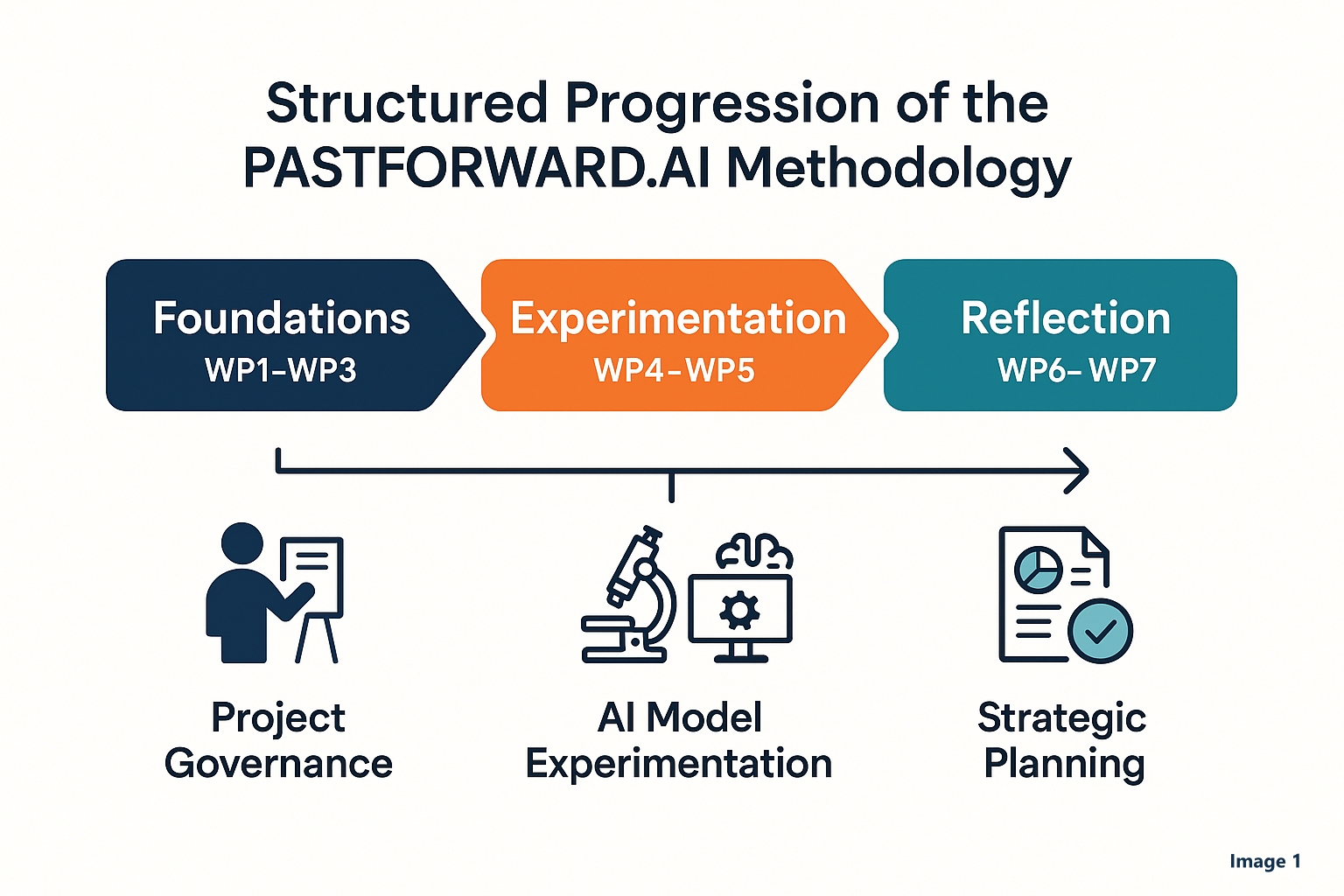
Foundations
Governance, data management and ethics are set up first, alongside a focused survey of open-source AI models and of international AI initiatives in cultural heritage. This phase produces the evidence base for everything that follows.
Experimentation
Models and use cases are selected and matched through workshops, interviews and multi-criteria analysis. The strongest pairings become proofs of concept, developed and iteratively tested on the institute's own GPU infrastructure.
Reflection
The proofs of concept are evaluated, lessons are synthesised, and the institute's readiness for AI is assessed honestly. The result is a strategic AI roadmap and a set of concrete recommendations, shared widely.
Timeline
48 months at a glance
The two coordination work packages run for the whole project, and dissemination starts almost immediately. The research work packages hand over to each other as the phases progress.
Work packages
Seven work packages, 42 deliverables
Each work package below can be unfolded to show its tasks and deliverables, with the project month in which each deliverable is due.
WP1 Coordination, project management and reporting M1–M48
Keeps the project on course: planning, risk management, reporting to BELSPO, and quality reviews of every major deliverable. A stakeholder committee of external experts meets at least four times during the project to challenge our direction and keep the work relevant.
- T1.1Project governanceM1–M48
- T1.2Project management and quality assuranceM1–M48
Deliverables
| D1.2.1 | Initial report | M3 |
| D1.1.1 | Minutes of the stakeholder committee kick-off meeting | M10 |
| D1.2.2 | First annual activity report | M12 |
| D1.1.2 | Minutes of the second stakeholder committee meeting | M22 |
| D1.2.3 | Second annual activity report | M24 |
| D1.1.3 | Minutes of the third stakeholder committee meeting | M34 |
| D1.2.4 | Third annual activity report | M36 |
| D1.1.4 | Minutes of the final stakeholder committee meeting | M46 |
| D1.2.5 | Final report | M48 |
WP2 Research data management and ethics M1–M48
Builds the data and ethics backbone of the project: a living data management plan aligned with the FAIR principles, a backup and security strategy following the 3-2-1 rule, and an AI ethics assessment framework that is applied and refined throughout the project. An ethics issue log keeps a transparent record of dilemmas and how they were resolved.
- T2.1Development of a data management plan and compliance with FAIR principlesM1–M48
- T2.2Implementation of data security measures through backup policiesM1–M48
- T2.3Upholding responsible research practices and addressing AI-specific ethical principlesM3–M48
Deliverables
| D2.1.1 | Data management plan | M6 |
| D2.3.1 | Initial AI ethics assessment framework and responsible research guidelines | M12 |
| D2.2.1 | Report on data security during the project | M48 |
| D2.3.2 | Final report on responsible research practices, AI ethics framework and log | M48 |
WP3 Focused survey of AI models and initiatives in cultural heritage M1–M15
Maps the landscape before anything gets built. The team shortlists promising open-source models for the five application areas, using strict criteria such as licensing, ease of deployment and minimal fine-tuning needs. In parallel it studies international AI initiatives in cultural heritage, with the AI4LAM community as a key source, and distils everything into actionable lessons.
- T3.1Define the research scope and prioritisation methodologyM1–M4
- T3.2Identify and document a shortlist of promising AI modelsM2–M9
- T3.3Identify and document key international initiatives and learningsM4–M12
- T3.4Analyse findings and synthesise actionable lessonsM9–M15
Deliverables
| D3.1.1 | Research scope, prioritisation criteria and methodology | M4 |
| D3.2.1 | Report on shortlisted and prioritised AI models | M9 |
| D3.3.1 | Report on international AI initiatives and best practices | M12 |
| D3.4.1 | Actionable lessons and recommendations for the proofs of concept | M15 |
WP4 Selection, prioritisation and mapping of AI models and use cases M6–M22
Turns the broad survey into concrete targets. Colleagues across departments and partner federal scientific institutions bring in real use cases through workshops, interviews and surveys. Models and use cases are then scored, prioritised and mapped to each other, ending in a shortlist of model and use case pairings recommended for proof-of-concept development.
- T4.1Selection and prioritisation of AI modelsM9–M16
- T4.2Identification and documentation of potential use cases with other federal scientific institutionsM6–M15
- T4.3Evaluation and prioritisation of potential use casesM15–M18
- T4.4Mapping of prioritised models to prioritised use casesM17–M20
- T4.5Refinement of recommendations for the proofs of conceptM20–M22
Deliverables
| D4.2.1 | Draft inventory of potential AI use cases | M15 |
| D4.1.1 | Report on selected and prioritised AI models | M16 |
| D4.3.1 | Inventory and prioritisation of potential AI use cases | M18 |
| D4.4.1 | Model-to-use-case mapping matrix and fit assessment | M20 |
| D4.5.1 | Recommendations for proof-of-concept development | M22 |
WP5 Development of proofs of concept M22–M42
The hands-on phase. Each selected pairing gets a detailed plan with measurable success criteria, curated datasets, and a reproducible technical environment on the institute's own servers. Development is iterative, with testing and refinement running in parallel, and everything is documented so the results can be reproduced and reused. The finished proofs of concept are demonstrated to stakeholders.
- T5.1Detailed planning and design for each selected proof of conceptM22–M24
- T5.2Data preparation and curationM23–M27
- T5.3Technical environment setup and model integrationM24–M28
- T5.4Development and implementation of the prototypesM26–M38
- T5.5Testing, evaluation and refinementM28–M40
- T5.6Documentation of the development process, challenges and resultsM26–M41
- T5.7Demonstration and presentation of the proofs of conceptM39–M42
Deliverables
| D5.1.1 | Detailed proof-of-concept plans | M24 |
| D5.2.1 | Curated datasets for development | M27 |
| D5.3.1 | Development and testing environments established | M28 |
| D5.4.1 | Demonstrable proof-of-concept implementations | M38 |
| D5.5.1 | Test results and refinement logs | M40 |
| D5.7.2 | Recommendations for the WP6 evaluation | M40 |
| D5.6.1 | Technical documentation and evaluation report per proof of concept | M41 |
| D5.7.1 | Demonstration materials and session records | M42 |
WP6 Evaluation of the proofs of concept and strategic roadmap M40–M48
Looks back to plan forward. The proofs of concept are evaluated against their success criteria and their potential to scale. Lessons from the whole project are synthesised, the institute's readiness for AI is candidly assessed, and everything feeds into a strategic AI roadmap with concrete recommendations for the next steps.
- T6.1Comprehensive evaluation of the developed proofs of conceptM40–M43
- T6.2Synthesis of project findings and lessons learnedM41–M44
- T6.3Assessment of long-term AI integration potential and organisational readinessM42–M45
- T6.4Development and prioritisation of the strategic AI roadmapM44–M47
- T6.5Formulation of recommendations for next stepsM46–M47
- T6.6Reporting and dissemination of the evaluation and roadmapM47–M48
Deliverables
| D6.1.1 | Aggregated evaluation data and stakeholder feedback | M43 |
| D6.2.1 | Comprehensive evaluation report | M44 |
| D6.3.1 | Organisational AI readiness assessment and gap analysis | M45 |
| D6.4.1 | Strategic AI roadmap | M47 |
| D6.5.1 | Recommendations for immediate next steps | M47 |
| D6.6.1 | Final project report and recommendations | M48 |
WP7 Dissemination and valorisation M2–M48
Makes sure the results leave the building. This website and the blog are part of it, alongside tailored materials for heritage professionals, researchers and policymakers, presentations at conferences and workshops, peer-reviewed publications, and the open-source release of the proof-of-concept code. Networks such as AI4LAM, ICOM and the Europeana Network Association help the results travel.
- T7.1Valorisation activities onlineM2–M48
- T7.2Dissemination towards target groupsM12–M48
- T7.3Scientific valorisation of the project resultsM18–M48
Deliverables
| D7.1.1 | Project website and online presence established | M2 |
| D7.1.2 | Publicly accessible digital project outputs | M48 |
| D7.1.3 | Open-source proof-of-concept code with technical documentation | M48 |
| D7.2.1 | Report on dissemination activities and outreach | M48 |
| D7.3.1 | Scientific publications submitted | M48 |
| D7.3.2 | List of scientific presentations at conferences and workshops | M48 |